General Linear Models In Machine Learning | Realcode4you
Terminology for statistical models
Simple
‘Simple’ in simple linear regression refers to the mathematically simplest form of a relationship between two variables which is a straight line y=a+bx.
Linear
Linear in this context means a ‘linear combination’ of variables, it does not mean a straight line. In fact, adding a quadratic term into a statistical regression model is still considered a linear model.


ANOVA
Usually refers to the variations we saw last week (with any number of factors).
If it includes a continuous explanatory variable (covariate) it might be called ANCOVA (analysis of covariance).
Regression
Regressus in Latin means ‘to return’. The statistical meaning of the modern word regression is to return one variable to a form of another: to regress y on x (to return y to a form of x).
The first person to use it statistically didn’t really use it this way, but it ended up catching on for part of his analysis, so now that’s what we call it.
General linear model
The general form of any linear model for any combination of factors and covariates is a general linear model.
However, you may find that it can also be called a linear model or simply a regression model.
The specific words which are used are likely to depend on which discipline or subject area you are in.
Occasionally a research paper may state that it is using a ‘regression model’ in the abstract, but once you read the methods and results you realise they are actually doing something quite complicated.

Simple linear regression [revision]


x is the independent variable
y is the dependent variable
(The ‘hat’ on the y means we are referring to the predicted value.)

Finding the line of best fit visually


How good is the model?

Example


Interpreting the intercept and slope
The null hypothesis for each test is that the parameter = 0
(Almost) always include an intercept even if it isn’t significant
Excluding the intercept can force the slope to do something weird

Interpreting the model
R2: Coefficient of determination
R2 in simple linear regression is the same as r2 (correlation squared)
This is the proportion of variation in the outcome that we can explain with our model.
In more complicated models the R2 is calculated a little differently but interpreted the same way.
Adjusted R2 makes an adjustment based on sample size compared with the number of variables, this is to prevent ‘overfitting’.
What is overfitting?
Fitting too close to the sample data, such that it is unlikely to generalise to the population.


Assumptions of a linear model
Suitability & lack of influential outliers: All responses were generated from the same process, so that the same linear model is appropriate for all the observations.
Linearity: The linear predictor captures the true relationship between expected value of the response variable and the explanatory variables (and all important explanatory variables are included).
Constant variance: The residuals have constant variance.
Distribution: The residuals are normally distributed around the predicted values.
Independence: The observations are statistically independent of each other.

Four famous datasets – same statistics:


Including more variables in the models
Interpretation of each variable is similar to anova (factors) and regression (covariates).
The null hypothesis for each variable is that the difference/slope is zero after adjusting for other variables in the model.
If you change the model the p-values will change.
Model building & selection we will see next week
Some additional checks are needed for larger models
Additional checks before analysis
Are each of the independent variables providing different information?
Explore the relationships between the independent variables
Scatterplot matrix is helpful

Residuals versus each of the predictor variables

Examples
1.Exploration
This will depend on the data and variable types
2.Model statistics
3.Assumptions & residual checks
4.Modifying the model


Example 1 (Body fat and BMI)



Modifying the model
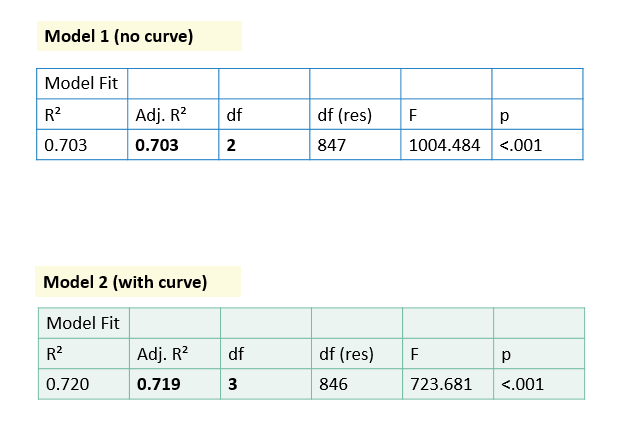
There is an extremely slight curve in the data.
We can try adding this into the model and comparing the model fit and significance.
The simplest curve to include is a quadratic (squared term).
To do this we create a new variable (BMI_squared) and include this as a term in the model.


Example 2 (Elderly and loneliness)

These are the variables we will use from the data. The name of the variable is given in brackets.
You can relabel your variable names if you find that easier if you are following along with the example.
Outcome:
loneliness (ULSscore)
Covariates:
depression (PHQ9score)
anxiety (GAD7score)
dementia (AD8)
insomnia (ISI)
With each of these measures a higher score indicates worse symptoms.


Patterns
‘Banding’ – data falling into lines
Artefact of measuring
Not necessarily a problem
‘Floor’ effect
About 64% of people score the minimum value 6.
Many people are not lonely, this feels more like a classification than a continuous measure in this context
The measure doesn’t go low enough to capture variation at this end
If the measure didn’t go high enough this would be a ‘ceiling’ effect
Modify the model?
Not really
Needs a different model
Maybe a (zero inflated) Poisson model for count data
Maybe classify people as lonely (yes/no) and use logistic regression
We will see these later on


For more details you can contact us or send your requirement details at:


Comments